
Belbin Team Roles Training Turning Team Diversity Into Performance
Most leaders can tell you who the “strong performers” are on their team. Far fewer can tell you why a team of strong performers sometimes still underdelivers. Belbin Team Roles gives HR leaders, OD/L&D managers, and government agency officials in Singapore a practical, research-backed lens for answering that question — and for doing something about it. Here we share with you how we helped Ministry of National Development leverage on the use of Belbin Team Roles for their Directors.
Developed by Dr. Meredith Belbin after years of studying management teams at Henley Business School, the framework identifies nine behavioural roles people naturally gravitate toward in team settings — from the ideas-driven Plant and the big-picture Shaper to the detail-focused Completer Finisher and the harmony-seeking Teamworker. Unlike personality tests that describe who someone is in isolation, Belbin is explicitly about how people behave in relation to others when working toward a shared goal. That makes it one of the most actionable tools available for team building in Singapore’s fast-moving, cross-functional work environments.
Why Belbin Resonates With Singapore Organisations
Singapore’s public and private sector teams are often lean, matrixed, and under pressure to deliver across silos. Statutory boards run cross-agency taskforces. Multinationals staff project teams with people who have never worked together before. In both cases, the usual approach — hire smart people, assign clear KPIs, hope for the best — misses a critical variable: whether the mix of people can actually function as a team.
Belbin Team Roles training addresses this directly. Instead of treating team dysfunction as a personality clash to be smoothed over, it reframes it as a role imbalance to be diagnosed and corrected. A team overloaded with Shapers and Plants may generate exciting ideas but struggle to finish anything. A team full of Implementers and Completer Finishers may execute reliably but rarely challenge the status quo. Naming these patterns gives teams language to discuss friction without it becoming personal — which is especially valuable in Singapore’s relationship-oriented, harmony-conscious workplace culture.
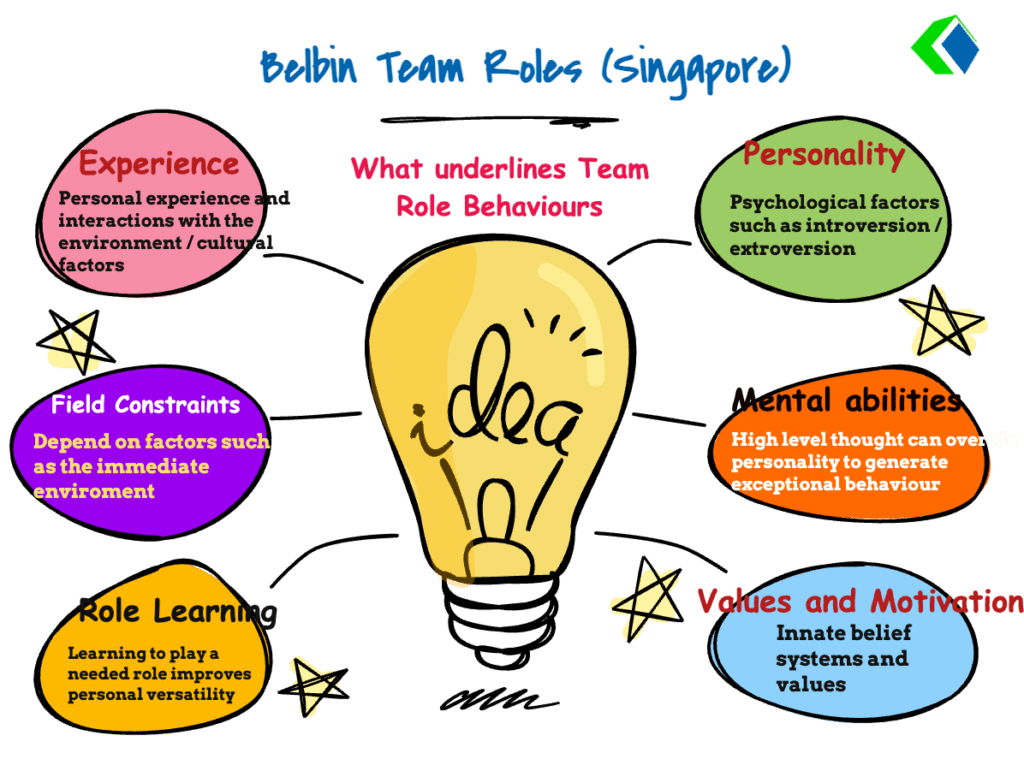
How It’s Used in an Actual Facilitation Session
In practice, a Belbin-based team development session rarely stops at “here are your results.” A well-run programme typically unfolds in three stages.
Stage 1: Individual and observer assessments. Participants complete the Belbin Self-Perception Inventory, and — critically — a small number of colleagues also complete Observer Assessments on each participant. This dual-lens approach is what separates Belbin from single-rater tools; it surfaces the gap between how someone sees their own contribution and how the team actually experiences it.
Stage 2: Team composition mapping. The facilitator plots the whole team’s roles on a single chart, revealing gaps (roles the team lacks entirely), clusters (roles that are over-represented), and “team role tension points” where two strong personalities may be pulling in different directions during high-stakes moments.
Stage 3: Applied scenario work. This is where the session earns its keep. Rather than ending with a debrief slide, the facilitator runs the team through a live planning exercise — often tied to a real, current project — and coaches them in real time on how to deploy underused roles and manage overused ones.
A Composite Example
Consider a mid-sized statutory board preparing to launch a new digital service. The project team of eight was heavy on Implementers and Monitor Evaluators — careful, methodical, risk-aware — but had only one weak Plant and no Resource Investigator. Early meetings were thorough but stalled: nobody was pushing genuinely new ideas or scouting what other agencies and vendors were already doing externally.
During the Belbin session, the facilitator didn’t tell anyone to “be more creative.” Instead, the team recognised the gap on their own composition chart and deliberately assigned two members to temporarily flex into the Resource Investigator role for the next planning sprint — actively researching external benchmarks and bringing outside perspectives into the next three meetings. Within weeks, the quality and originality of proposed solutions visibly improved, without changing a single person on the team.
This is the core value proposition of Belbin Team Roles training: it doesn’t ask organisations to rebuild their teams. It asks them to understand and rebalance the ones they already have.
Where Belbin Fits in a Broader Talent Strategy
Belbin works particularly well as part of a wider suite that might also include Everything DISC, the Big 5 personality assessment, or 5 Behaviours of a Cohesive Team — each answering a slightly different question (behavioural style, underlying traits, trust and accountability dynamics, respectively). For government agencies running leadership development tracks, or private-sector HR teams designing onboarding for newly formed project units, Belbin is often the natural starting point because it ties so directly to observable team output.
It’s also well suited to strategy planning offsites, where understanding who naturally challenges assumptions (Shapers, Monitor Evaluators) versus who ensures ideas get executed (Implementers, Completer Finishers) can materially change how a strategy session is designed and facilitated.
Bringing Belbin Into Your Organisation
Belbin Team Roles training works best when it’s facilitated by someone experienced in reading team dynamics live in the room — not just distributing a report and moving on. Whether you’re a government agency assembling a new taskforce, or an HR/L&D leader looking to strengthen an existing department, a structured Belbin session can turn abstract “team chemistry” concerns into a concrete, actionable development plan.
Organisations that invest in understanding team dynamics through frameworks like Belbin often see measurable improvements in both collaboration quality and project outcomes, as evidenced by program evaluation data across sectors.
If you’re considering Belbin Team Roles training, DISC, Big 5, or 5 Behaviours facilitation for your team or organisation in Singapore, reach out to Ebnu Etheris at office@teamworkbound.com to discuss a session tailored to your team’s stage and challenges.
About the Author: Ebnu Etheris Ma.IDT, B.Hrd

Related Posts
- Categories: Belbin Team Roles, People analytics
Unlock team potential with Belbin's proven roles. Here understand the history and gravitas of how Belbin Team roles were formulated.
- Categories: Belbin Team Roles, People analytics
Go behind the scenes of a Teamworkbound Belbin Team Roles session in Singapore — from icebreaker to team placement, step by step.
Top 10 activities
This blog will showcase top 10 experiential activities that we have conducted in our training programs. Included are models associated with experiential learning, team dynamics, understanding personality and leadership. We will showcase crisp summary of good books we have read on this blog as well.
Ebnu Etheris
MA.IDT and B. Ed & Trn
Founder Teamworkbound
Magazine Feature
Personal Excellence Magazine (Aug 2014 issue) based in Canada featured our article.

Human Resources Magazine (July 2012 issue), featured Teamwork Bound views on what it takes to engage senior managers.
Our Evaluations
Blog articles
Get started with Teamwork Bound
Want to learn what Teamwork Bound can do for you? See for yourself with a free trial, tests and short in house speaking engagements. We will assure you that our program evaluations meet 85% percentile score, failing which we will not charge for our training sessions.