
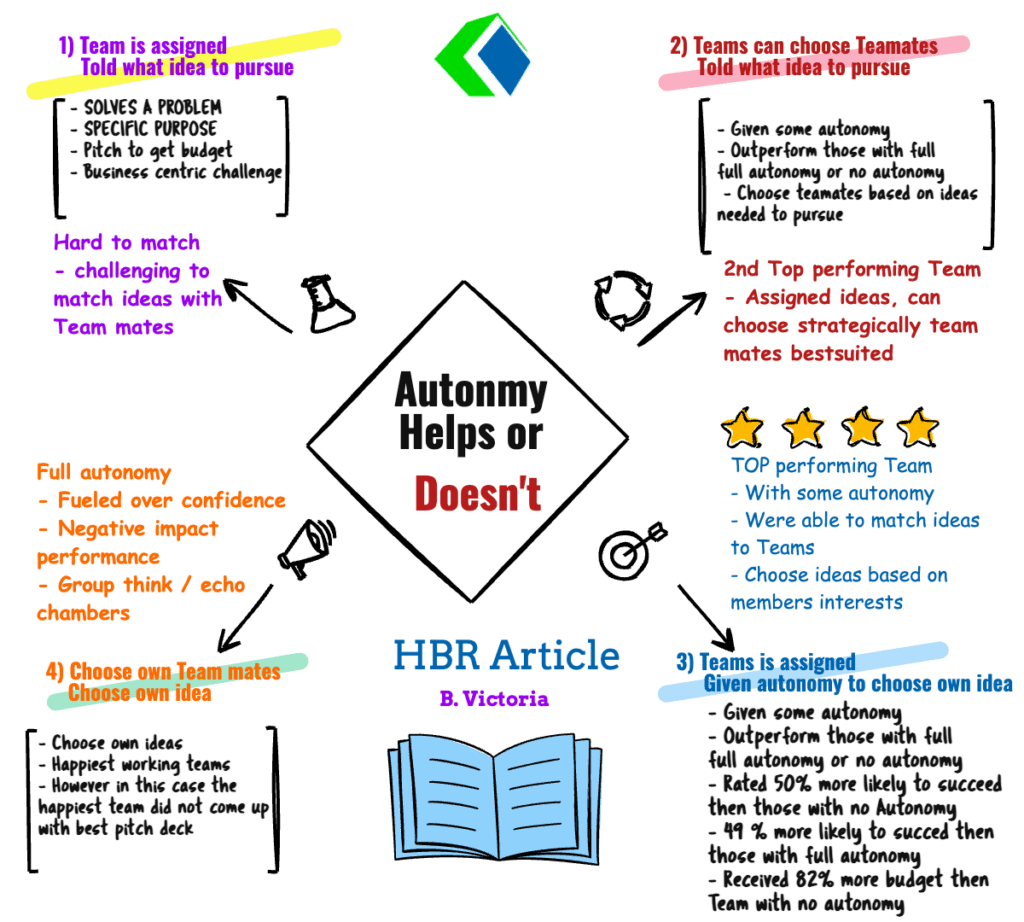
The HBR Autonomy graphic
Autonomy, Control and Team Performance — What the Research Tells Us
Does Giving Your Team Autonomy Actually Help?
Most managers in Singapore wrestle with the same question: how much control should you hold, and how much freedom should you give your team? A landmark research article published in the Harvard Business Review — When Autonomy Helps Team Performance — and When It Doesn’t by Boss, Dahlander, Ihl, and Jayaraman — offers some surprising answers.
The researchers set up an experiment where teams had to pitch a business proposal to seasoned executives. Based on the quality of their pitch, teams were allocated a budget to execute their idea. The setup may sound familiar — it mirrors what happens in many organisations daily. The key markers were:
- Solve a real problem
- Share a specific purpose
- Pitch to secure a budget
- Address a business-centric challenge
What made this experiment revealing was that the teams were structured with varying levels of autonomy — in both how the team was formed and what task they pursued.
How Were the 4 Teams Formed?
Before we look at results, it’s worth noting that Daniel H. Pink, in his influential book Drive, identified three building blocks of an engaged and high-performing team: Purpose, Autonomy, and Mastery. Pink was quick to clarify that this isn’t unfettered freedom — it’s autonomy within a set of broad but clear markers. Our Dan H. Pink Drive Workshop explores exactly this concept in a practical team setting.
The four teams in the HBR study were structured as follows:
- Team 1 – Assigned team, assigned task (classic top-down, dictatorial approach)
- Team 2 – Chose their own teammates (autonomy), but were told what idea to pursue
- Team 3 – Assigned team (limited autonomy), but could choose their own idea
- Team 4 – Chose their own teammates AND their own idea (full autonomy)
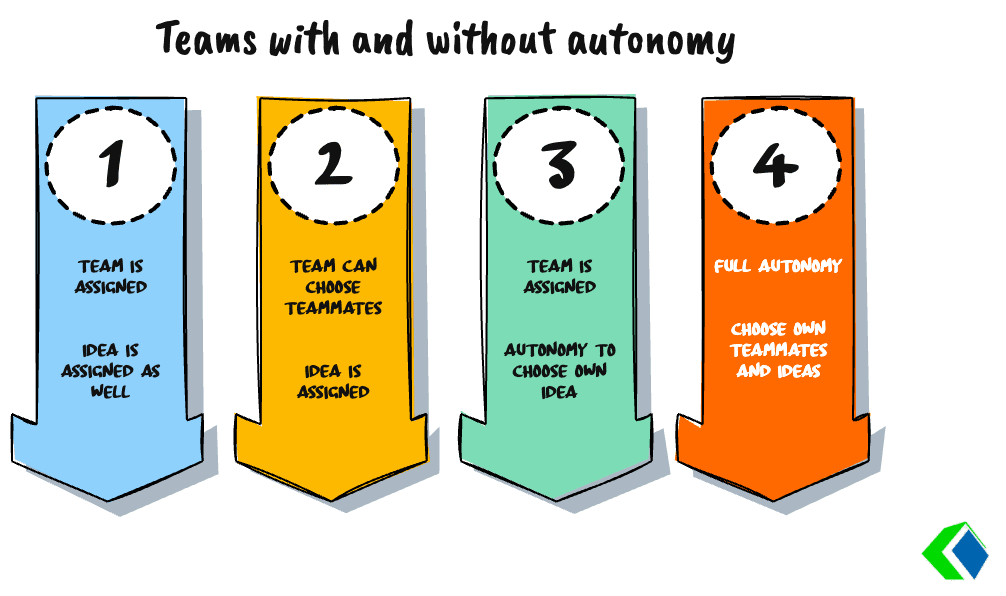
The 4 Teams diagram
How Did Each Team Perform?
The results were genuinely eye-opening:
Team 1 — Worst performing. When everything is dictated, you rarely get the best from your people. The core problem? It was nearly impossible to match the assigned task with the right mix of skills among teammates.
Team 2 — 2nd best performing. Even with a prescribed idea, the freedom to choose teammates strategically made a significant difference. Selecting people whose strengths suited the task gave this team a real edge over those with no autonomy at all.
Team 3 — Best performing overall. This is the most instructive finding. An assigned team with the freedom to pursue their own idea outperformed everyone:
- 50% more likely to succeed than teams with no autonomy
- 49% more likely to succeed than teams with full autonomy
- Received 82% more budget than Team 1
Team 4 — Full autonomy, but not top performers. The happiest group — they chose their teammates and their idea — but did not produce the best pitch. Full autonomy without structure can lead to teams that are comfortable, but not necessarily effective.
What This Means for Building Teams in Singapore
The research points to a clear insight: the best-performing team was not the freest one — it was the most strategically composed one, given just enough autonomy to own their direction.
This raises a practical question for leaders and HR practitioners: how do you intentionally assign a team that is set up to succeed?
This is precisely where Belbin Team Roles programs in Singapore become a powerful tool.
Belbin Team Roles — The Science Behind Assigning the Right Team
Dr Meredith Belbin defined a Team Role as one of nine clusters of behavioural attributes, identified through decades of research at Henley Business School, designed to facilitate team progress. Importantly, Belbin measures behaviour, not personality — which means the insights are directly actionable in the workplace.
The nine roles span three clusters:
- Social Roles: Resource Investigator, Teamworker, Co-ordinator
- Thinking Roles: Plant, Monitor Evaluator, Specialist
- Task Roles: Shaper, Implementer, Completer Finisher
Connecting this back to the HBR research: Team 3 succeeded because it had the right people for the task. With Belbin, leaders no longer have to rely on guesswork or seniority when assembling teams. You can identify who brings creative thinking (Plant), who will drive execution (Shaper, Implementer), and who will ensure quality outcomes (Completer Finisher) — and build your team accordingly.
A common myth worth busting: you don’t need nine people to cover nine roles. Most individuals naturally carry two to three Belbin roles, and not all roles are needed simultaneously — what matters is matching the right behaviours to the right phase of the task. You can explore more about this in our Belbin Team Roles OD Toolkit.
We’ve also written extensively about how Belbin works in practice — browse our full collection of Belbin articles and case studies to see how organisations in Singapore and the region have applied it.
Autonomy Works Best When the Team Is Right
The HBR research and Belbin’s framework point to the same conclusion: autonomy is most powerful when it sits within a well-composed team with clear roles. Giving a poorly assembled team full autonomy often leads to comfortable conversations but weak outcomes. Giving a role-balanced team the freedom to pursue their own ideas? That’s where performance accelerates.
If you’re interested in how Belbin connects to broader strategy execution, read our article on Belbin Team Roles for Strategy Execution, and how high-performing teams can break silos and execute together.
How Teamworkbound Can Help
At Teamworkbound Singapore, we have delivered Belbin programs in Singapore across government ministries, MNCs, C-suite leadership teams, and industry sectors ranging from petrochemicals to healthcare.
Is your team struggling to get projects off the ground? Are you constantly revising KPIs downward and finding it hard to explain why to your stakeholders? Our Belbin Team Roles Program is designed to give your team the clarity, language and structure to perform at their best — with the right level of autonomy built in.
We also offer a broader suite of team performance programs and the Effective Leadership Program for leaders who want to understand how to manage autonomy, drive and performance in their teams.
Our programs consistently score in the 85th percentile on evaluation — or we don’t charge.
Get in touch with us today to explore how we can help elevate your team.
References: Boss, V., Dahlander, L., Ihl, C., & Jayaraman, R. (n.d.). When autonomy helps team performance — and when it doesn’t. Harvard Business Review. https://hbr.org Belbin. (n.d.). The nine Belbin team roles. https://www.belbin.com/about/belbin-team-roles/
About the Author: Ebnu Etheris Ma.IDT, B.Hrd

Related Posts
- Categories: Belbin Team Roles, People analytics
Unlock team potential with Belbin's proven roles. Here understand the history and gravitas of how Belbin Team roles were formulated.
- Categories: Belbin Team Roles, People analytics
Go behind the scenes of a Teamworkbound Belbin Team Roles session in Singapore — from icebreaker to team placement, step by step.
Top 10 activities
This blog will showcase top 10 experiential activities that we have conducted in our training programs. Included are models associated with experiential learning, team dynamics, understanding personality and leadership. We will showcase crisp summary of good books we have read on this blog as well.
Ebnu Etheris
MA.IDT and B. Ed & Trn
Founder Teamworkbound
Magazine Feature
Personal Excellence Magazine (Aug 2014 issue) based in Canada featured our article.

Human Resources Magazine (July 2012 issue), featured Teamwork Bound views on what it takes to engage senior managers.
Our Evaluations
Blog articles
Get started with Teamwork Bound
Want to learn what Teamwork Bound can do for you? See for yourself with a free trial, tests and short in house speaking engagements. We will assure you that our program evaluations meet 85% percentile score, failing which we will not charge for our training sessions.